
Chino Material Care Guide
Learn how to clean and care for your chino pants. From washing to drying to ironing, proper care will ensure that your chinos last long…
Chino Material Care Guide
HOW TO WASH CHINOS
Chinos are a versatile essential that blend style with durability, and if you take care of them, your favorite chinos can last a long time. This guide covers the best way to clean and care for chinos.
WHAT IS CHINO FABRIC?
Chino fabric is usually made out of cotton or a cotton-synthetic blend with twill construction. Many modern chino pants are blended with elastane to add stretch. Chino twill fabric is used in a variety of clothing styles because it’s durable and easy to care for.
Volcom Global Denim and Pants Designer, Howie, says:

“Chino fabric can turn a simple dress-down chino to an edgy dress-up chino. It can make you look classic or add street style – it’s a versatile piece that is up for each wearer’s interpretation.”

CHINO MATERIAL WASHING & DRYING INSTRUCTIONS
- Turn your chinos inside-out before adding them to the wash. If possible, group with other cotton clothes (not a deal-breaker, but chinos are a tougher material that can wear down other fabrics).
- Set the water temperature to cool or lukewarm and choose a gentle or normal wash cycle. Regular detergent works just fine, just make sure to check the label for how much to add because adding too much can leave a film on your clothes that wears them out quicker.
- Remove your chinos from the wash as soon as they’re done – letting them sit for prolonged periods can cause creases. If you want to soften your chinos, you can place them on a tumble dry with low heat, though this could cause them to slightly shrink. Air-drying is the best way to prevent fading and shrinkage.
WHAT COLORS TO WASH CHINOS WITH
Modern washing machines and laundry detergents give you more flexibility when it comes to mixing colors. That is, most chinos can be washed with a variety of colors. Of course, you want to separate them from white fabrics. Also, if you wash light chinos with black fabrics (like a brand new sweatshirt), the black dye could bleed and darken the chino. It’s always better to wash colored fabrics with cold water to reduce discoloration and fading.
Volcom Global Denim and Pants Designer, Howie, says:
“Much like all other clothing – wash darks with darks, whites with whites, and never a red with a light fabric, to be safe.”

HOW OFTEN TO WASH CHINOS
Volcom Global Denim and Pants Designer, Howie, says:
“I would suggest washing chinos every 4 to 5 wears, but it’s all up to personal preference.”
If you want your chinos to last longer and fit better, don’t wash them after every wear. The frequency really depends on how and where you wear them. If you’re skating and sweating in your chinos on a daily basis, you’ll probably need to wash them more frequently – at least once a week.
But, if you lightly wear your chinos in casual settings every couple of days, you won’t need to wash them so often.
The benefits of not washing your chinos is that they maintain their color and fit. Everytime you wash and dry your pants, they can lose the natural fit you get from wearing them.
CLEANING STUBBORN STAINS
Even though washing machines will take care of most chino stains, there’s always a chance that they’ll pick up stubborn stains that require a little extra effort.
If stains remain after a wash, don’t put them in the dryer as the added heat will set the stains and make them harder to remove.
You can pretreat stains by adding a dab of liquid detergent on the stain and letting it sit for 10 minutes before the wash. If it’s grease, add a pinch of baking soda to the stain for 10-20 minutes to help draw it out of the fabric. Rinse the area with cold water before putting it to wash.
Most stains can come out with a standard wash, but if it’s a lighter fabric and a deep stain, any kind of commercial stain remover will work just fine. Make sure to test on a small, inconspicuous area first.
DO CHINOS SHRINK?
Volcom Global Denim and Pants Designer, Howie, says:
“Depending on the blend of the chino, some can shrink more than others. Stretch fabrications will shrink a little more due to the elasticity of the fabric when compared to a 100% cotton fabrication.
Woven fabrics have different shrinkage nuances, but we try to prewash all fabrics to account for shrinkage beforehand so that they don’t shrink when a consumer washes them (high heat washing and drying always distresses the fabric more than a cold wash and low heat tumble dry).”
If your chinos are too baggy or too long, machine drying can get them to fit a little better. But remember, as you wear pants, they will stretch out in all the right places and become more comfortable with each wear, so avoid overwashing them.

HOW TO IRON CHINOS
The great thing about chinos is that they don’t wrinkle easily. The most common cause of wrinkles is leaving them in the washing machine for too long after the cycle is complete. To reduce wrinkles, take them out of the machine and hang dry them as soon as possible.
If your chinos are still creased once dry, you can iron them for a cleaner, more structured look. The key to ironing chinos is to turn them inside out, set the iron to medium heat and use the steam button to help with stubborn creases.
Medium heat will prevent the iron from burning the fabric, but (depending on your exact iron) it might not be enough to remove stubborn creases. When this happens, using the steam button or spraying water directly on the fabric (if your iron doesn’t have a steam feature), will usually do the job.
If medium heat and added moisture aren’t working, you can turn up the heat in small increments. Exercise caution and always test a small, less visible spot first.
Volcom Global Denim and Pants Designer, Howie, says:
“A handheld steamer works just as well if an iron is not available. I find that ironing will make the fabric more “crisp” and more rigid looking, whereas a steamer can make the drape of the fabric look more lived in but wrinkle free.”
If you’re in a pinch, you can always hang them in the bathroom while you take a hot shower. The steam will help relax the fabric.
HOW TO AVOID FADING
Here are some tips for preventing chinos from fading:
- Don’t put them in the dryer.
- Don’t wash them too often.
- When you do wash them, flip them inside out.
- Don’t air-dry them in direct sunlight.
Volcom Global Denim and Pants Designer, Howie, says:
“Don’t leave your chinos, or any other clothing, in the sun for too long – the UV rays will sun bleach the fabric. Also, avoid sweating in chinos because the salt from your sweat can create a reaction on the fabric that makes it look bleached. And lastly… don’t ever wash them. Just kidding, but not really.”

HOW TO SOFTEN STIFF CHINOS WITH VINEGAR
If you have new chinos that are a little stiff, you can soften them by hand or machine washing.
SOFTENING CHINOS BY MACHINE WASHING
- Add a cup of white vinegar to your washer’s rinse cycle and set the water temp to cool. While fabric softener can help make chinos softer to the touch, it shortens the lifespan of clothes by adding a chemical layer to them.
- Run the wash cycle like normal and remove the chinos as soon as the wash cycle is done.
- You can tumble dry your pants to help soften them, but air drying is the best method for protecting the integrity of the fabric.
- If they’re still stiff, you can try machine drying them with dryer balls or other clothing items with rougher fabrics (like denim), but be aware that this could slightly shrink your chinos.
SOFTENING CHINOS BY HANDWASHING
- Fill a bucket or basin with cool water and add one cup of white vinegar.
- Turn your chinos inside-out and submerge them in the combination.
- Gently swish them around the water to ensure that all of the fabric is soaked, then allow them to sit in the solution overnight.
- If your chinos are extra stiff, you can try adding a dime-sized amount of hair conditioner to the solution before soaking.
- Once ready to dry, remove the chinos and place them on a flat towel. Roll the towel to absorb excess moisture.
- Lay them flat on a towel to dry or hang them from pant hangers in a well-ventilated and shaded area until dry. The smell of vinegar should disappear once dry.
Chinos are durable and work with almost any style, which is why they’re a crowd favorite. And if you properly care for them, your favorite pair of chinos can last years.
What is GORE-Tex?
Discover everything you need to know about chinos – where they came from, what they’re made of, and the variety of styles they come in.
What is GORE-Tex?
HOW IT WORKS
When it comes to waterproof fabrics, GORE-TEX is one of the most trusted and reputable technologies. It’s unique because it’s waterproof and windproof, while also being breathable.
The fabric blocks liquid water but allows air and water vapors to pass through it. For snow sports, this means that it keeps rain and snow out while allowing sweat to escape from your body. But, how does GORE-TEX work exactly?
GORE TEX CONSTRUCTION
The magic of GORE-TEX is all in the proprietary waterproof membrane – the membrane is bonded to the inside of a layer. It’s almost like an invisible layer that reinforces the fabric it’s bonded to.

You’ll notice that GORE-TEX fabrics don’t always have the same texture or sheen on the outside. That’s because there are different types of GORE-TEX fabrics designed with different outdoor activities in mind. You’ll also notice that some snow apparel brands use GORE-TEX technology in their designs.
2L VS. 3L MEMBRANE CONSTRUCTION
2L and 3L are the two most common types of GORE-TEX membranes. GORE-TEX 2L consists of two bonded layers and GORE-TEX 3L has three bonded layers.
2L = Outer layer + membrane
3L = Outer layer + membrane + lining
It’s important to note that this only accounts for the number of layers that make up the actual GORE-TEX fabric and not the entire outerwear piece. Most 2L jackets have a separate hanging lining and/or insulation, and 3L jackets are occasionally made with insulation in addition to the GORE-TEX fabric (though typically designed as just a shell).
2L VS. 3L GORE-TEX – WHICH IS BETTER?
2L is more common when it comes to snow outerwear because it’s less expensive and more than adequate for most riding conditions. Remember, the actual membrane offers the same waterproofing ratings.
The advantage of 3L is that it’s lighter because it doesn’t have a separate hanging lining on the inside, like a lot of 2L jackets. It’s also more breathable because the three layers are bonded together, allowing air and sweat to escape faster.
GORE-TEX GUARANTEE
GORE-TEX has a “Guarantee To Keep You Dry” promise that their fabrics are waterproof, windproof and breathable.
GORE-TEX PERFORMANCE BENEFITS
- Waterproof = Snow and rain stay out
- Windproof = Wind stays out
- Breathable = Air and sweat doesn’t stay in
WHAT IS THE DIFFERENCE BETWEEN GORE-TEX AND WATERPROOF?
GORE-TEX isn’t the only waterproof fabric, but it’s one of the most trusted and most popular because of its breathability – an important factor for snow outerwear since our bodies produce a lot of heat during snow sports.
Vinyl, for instance, is also waterproof, but isn’t breathable. If you were to spend a day snowboarding in a vinyl jacket, you would be drenched in sweat which could then freeze and become very uncomfortable, very quickly.

TYPES OF GORE-TEX
GORE-TEX has a line of fabrics and products that are designed for different needs. These are three of their most popular:
WHAT IS GORE-TEX PACLITE®?
As the name implies, GORE-TEX Paclite® is packable. It has the same waterproofing, windproofing and breathability – but in a lightweight shell. Paclite is particularly popular for jackets. You can keep them packed away in a small bag and bring them out when you need some added protection from the weather.
WHAT IS GORE-TEX INFINIUM®?
GORE-TEX Infinium® is a cool technology that puts the waterproof membrane on the outside of the fabric. So, as soon as water hits the fabrics, it beads up and runs off of the surface. Infinium products are still windproof and breathable.
WHAT IS GORE-TEX WINDSTOPPER®?
You probably guessed it, but GORE-TEX Windstopper® fabric is all about wind protection. In fact, it prioritizes wind protection and comfort over waterproofing. Windstopper fabrics don’t promise to keep you dry, but they are extremely lightweight, have 4-way stretch and are still very breathable. A Windstopper® jacket, for instance, could be perfect for cool morning jogs when you need something that won’t weigh you down or constrict your movement.

GORE TEX TESTING PROCESS
To ensure the utmost quality across their products and fabrics, GORE-TEX puts their fabrics through intense testing. They not only test to ensure their products are waterproof, windproof and breathable, they also test for comfort, durability and stretch.
The tests are conducted in different weather conditions using advanced machines. They have a rain room, a storm cube, and a stretching machine. Basically, they use science-based testing to make sure their products are ready for whatever the conditions.
WHAT IS GORE TEX USED FOR?
GORE-TEX is used for all types of activities but it is ideal for snowboarding and skiing. It can be tricky to stay dry and warm without overheating during a long day on the mountain, but having GORE-TEX gear can definitely help.
GORE TEX SNOW PANTS
Whether you’re a snowboarder, skier or just looking for a fabric that will fight off the elements, GORE-TEX is hard to beat. You’re bound to work up a sweat on long runs, even if it’s cold or snowing. The waterproofing will keep you dry while the breathability will prevent overheating, which is also convenient for when you have to sit on the ground to redo your bindings.

GORE-TEX SNOW JACKETS
As with pants, GORE-TEX is a great material for snow jackets. Considering the fact that it’s breathable, windproof, and waterproof, it’s great for any rigorous snow activity. Many people wear their GORE-TEX jackets all season long because it’s such a reliable material.

GORE TEX RAIN JACKETS
If you live in a milder but rainy climate, you can still benefit from a GORE-TEX jacket. The Paclite® and Infinium® products offer excellent waterproofing in jackets that are lightweight, comfortable and packable. Their lightweight design also makes them great for layering – wear them over a sweatshirt or fleece for added warmth.
GORE TEX GLOVES
GORE-TEX is also a good option for snow gloves. Whether you’re getting in and out of your binding throughout the day, or throwing snowballs, your gloves are often the wettest after a long day in the snow. Keeping your hands dry and warm is going to increase your comfort. In critical snow conditions, having gloves that aren’t waterproof can be dangerous because it can be hard to regulate your core temperature when your fingers, hands and arms start to get wet and cold.

GORE TEX SHOES
GORE-TEX shoes are good for a variety of uses. From trail running shoes to insulated winter boots, GORE-TEX keeps your feet dry in critical conditions. Whether you’re dealing with rain or snow, keeping your feet dry and comfortable will allow you to stay out in the elements for longer periods of time.
GORE-TEX is truly the standard-bearer when it comes to waterproof outerwear. From heavy snow days on the slopes to light rains in the city, the right piece of GORE-TEX outerwear will become essential to your year-round wardrobe.
What Are Chinos?
Discover everything you need to know about chinos – where they came from, what they’re made of, and the variety of styles they come in.
What Are Chinos?
Chinos are a versatile type of pant – commonly found in short and pant lengths – that are made with a specific type of fabric that’s lightweight and durable. You can style chinos for any occasion.

WHAT COLORS TO WASH CHINOS WITH
Modern washing machines and laundry detergents give you more flexibility when it comes to mixing colors. That is, most chinos can be washed with a variety of colors. Of course, you want to separate them from white fabrics. Also, if you wash light chinos with black fabrics (like a brand new sweatshirt), the black dye could bleed and darken the chino. It’s always better to wash colored fabrics with cold water to reduce discoloration and fading.
Volcom Global Denim and Pants Designer, Howie, says:
“Much like all other clothing – wash darks with darks, whites with whites, and never a red with a light fabric, to be safe.”
HOW OFTEN TO WASH CHINOS
Volcom Global Denim and Pants Designer, Howie, says:
“I would suggest washing chinos every 4 to 5 wears, but it’s all up to personal preference.”
If you want your chinos to last longer and fit better, don’t wash them after every wear. The frequency really depends on how and where you wear them. If you’re skating and sweating in your chinos on a daily basis, you’ll probably need to wash them more frequently – at least once a week.
But, if you lightly wear your chinos in casual settings every couple of days, you won’t need to wash them so often.
The benefits of not washing your chinos is that they maintain their color and fit. Everytime you wash and dry your pants, they can lose the natural fit you get from wearing them.
WHAT IS CHINO FABRIC?
Chinos are made of chino fabric, which was originally a purely cotton fabric constructed with a durable twill weave – similar to denim but in a lighter weight.
Nowadays, chino material is still woven but is sometimes mixed with polyester, nylon or elastane to improve durability and flexibility. Regardless of the mix of materials, chinos are a light and breathable alternative to denim.

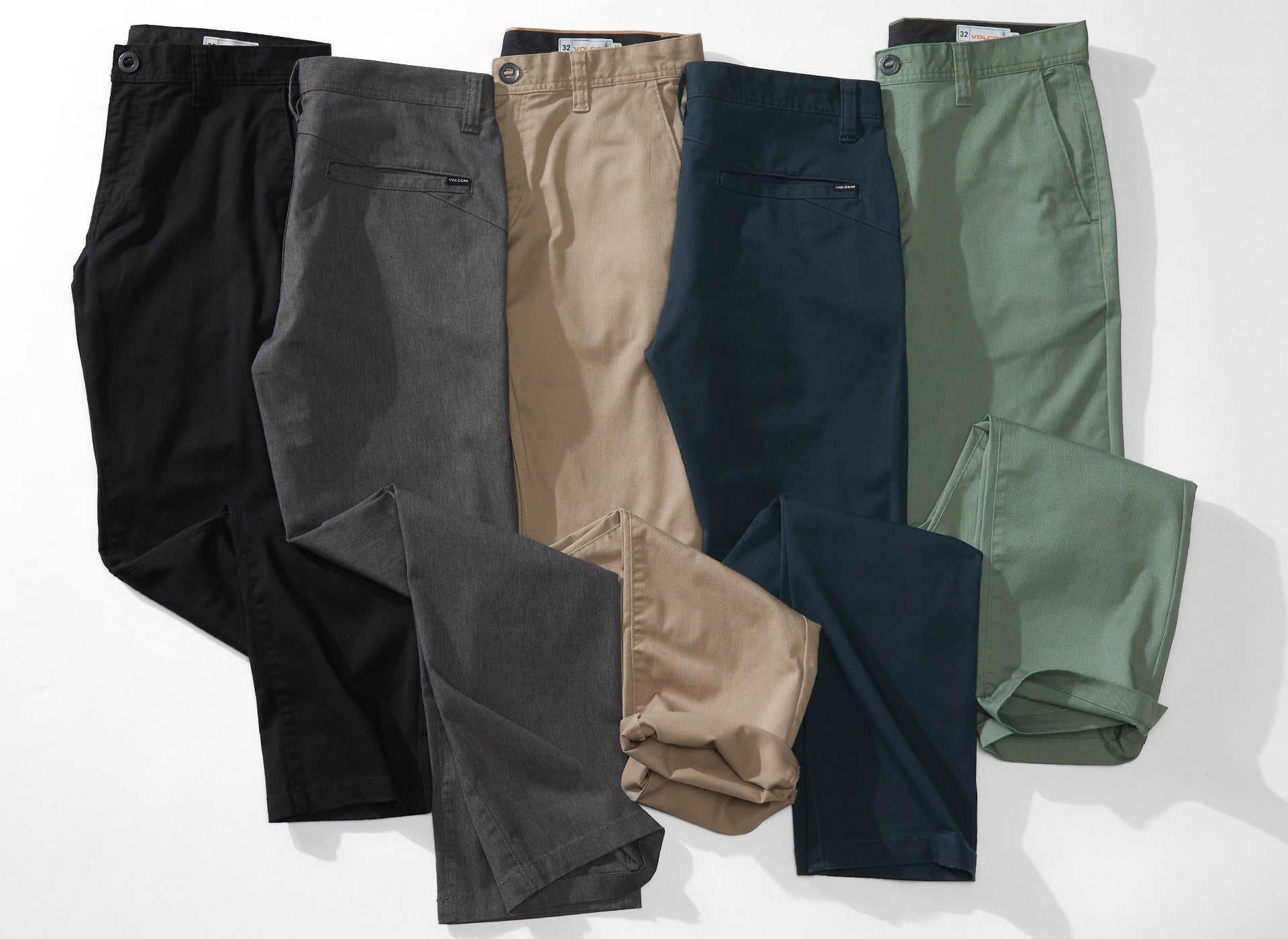
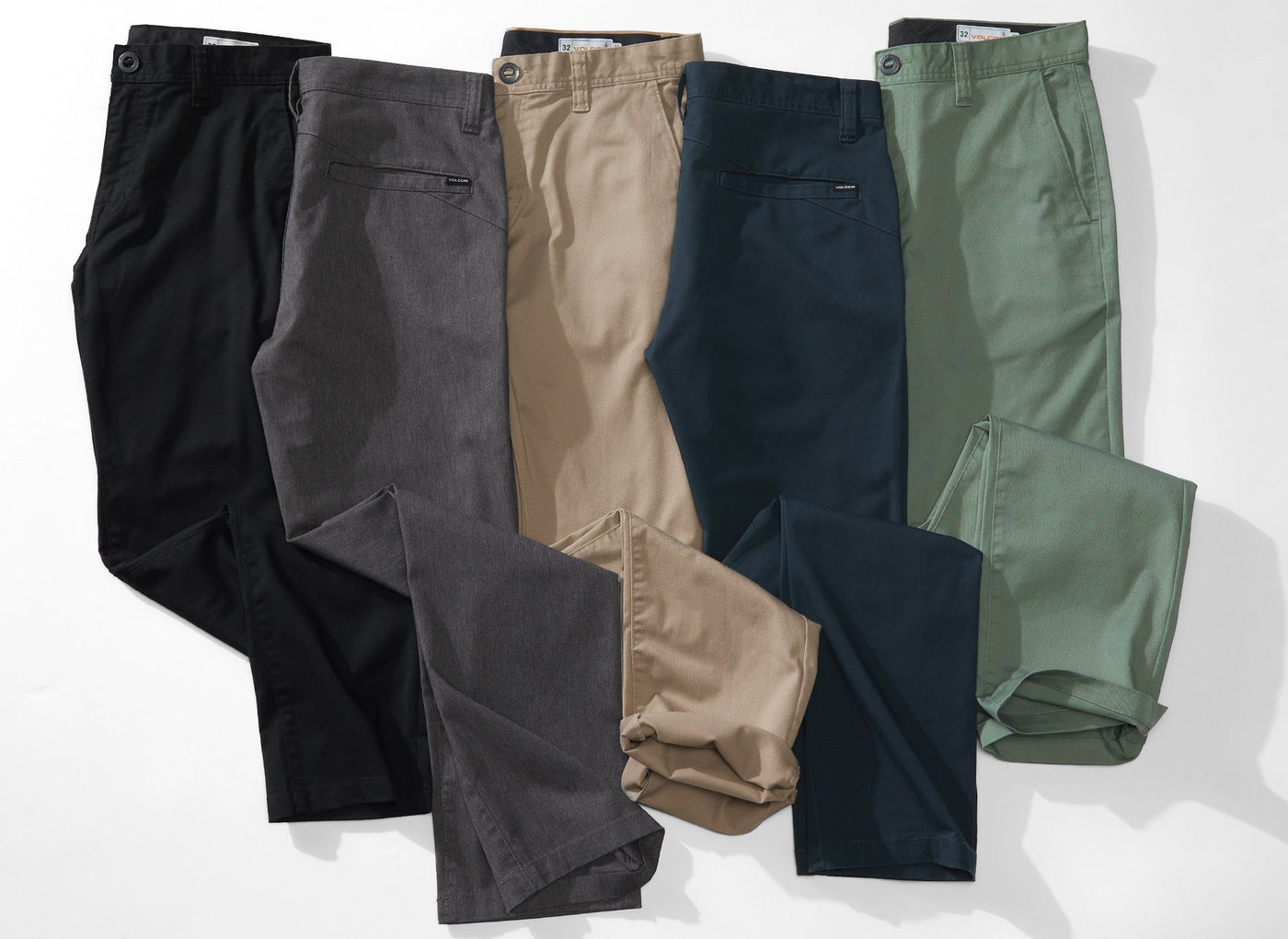
Chino fabric was originally dyed from white to a sandy, khaki color to help soldiers blend into the local environment. This khaki color is a staple, but today, chinos come in a range of shades and colors including black, navy blue, olive and more.

CHINO SHORTS
Chino shorts – also known as bermudas – are as versatile and durable as chino pants. Lengths generally come in short (17-18”), medium (19-20”) and long (21-22”).
ARE CHINOS THE SAME AS SLACKS OR KHAKIS?
Yes, with subtle differences.
Slacks are always tapered, meaning that they become a little narrower near the ankle, and while chinos do come in a tapered cut, they also come in a variety of other fits.
A defining characteristic of chino pants is that there is no pleat, differentiating them from formal pants and making them a good choice for a laid-back look.

Khakis, which come in similar colorways to chinos, and used to offer a more ample, straight-leg fit, but is now also a popular fit for chinos, especially within the skate community.
Lastly, the seams and visible detailing around pockets on chinos and slacks are more subtle than khakis.
CHINO PANTS HISTORY & ORIGIN
Chino pants have a long history, and like a lot of staples in men’s clothing, their origins lie in the military.
During the Spanish-American war, soldiers fighting in the Philippines found it quicker and easier to get clothes from China rather than having them shipped from the U.S.
These clothes were made of the lightweight, pure-cotton fabric which came to be known as chino fabric. The term “Chino” is the Spanish slang term for “China,” which led to chino pants.
Soldiers returning from the war continued to wear chino pants in their everyday lives, and the style became popular as it bridged the gap between slacks and jeans.

DIFFERENT CHINO STYLES
Although there can be differences between brands, chinos generally all come with:
- Five pocket design, including two side pockets, two back pockets, and a ticket pocket
- Fixed waistband with belt loops
- Zippered fly and button closure
Some of the most common styles, or fits, are:
- Slim/Modern – Tapered and close-fitting, offering the most tailored look without being as tight as skinny jeans
- Regular – Looser fitting than slim without being overly baggy and either straight or slightly tapered
- Loose – Providing ample room for movement and a comfortable fit with straight legs
Another main style difference of chino pants is the leg fit:
- Tapered – Wider at the thighs and thinner near the ankles, giving a more tailored look
- Straight – Same width the whole length of the leg, giving a looser look
HOW SHOULD CHINOS FIT?
Choosing the right fit for you comes down to personal preference.
That being said, there are a some things to consider when choosing a pair of pants:
- The waist should be the right size and your pants should stay up without the help of a belt.
- The top of the inseam shouldn’t sit so low that it interferes with your movement.
- The length, unless cropped, should be just enough to reach the tops of your shoes without bunching.
Chinos and chino fabrics have become a classic because of their durability and universal wearability. From workwear to more tapered styles, chino pants will always have their place in our lineup.